

Bridging the gap between rehab and high performance is the key to unlocking pain-free training for the long haul. If you ignore the warning signs, you likely know this story well: you love the feeling of a challenging workout, but a nagging pain constantly holds you back. This cycle continues because most lifters skip the essential step of movement screening and specific corrective exercise.
For too long, the standard advice has been to just rest and ice it. But true prehab is active, not passive. This guide moves beyond the outdated ‘wait and see’ method and provides a structural blueprint to identify and fix your limitations before they become injuries. As a sports science graduate with over 15 years of experience helping athletes and lifters overcome injury, I’ve seen firsthand that the key to long-term, pain-free performance isn’t rest; it’s intelligence. It’s about understanding the why behind your pain and implementing a systematic approach to fix it.
This is your complete system to diagnose, correct, and bulletproof your body. We will move beyond generic advice and provide a practical, science-backed framework to self-assess your movement, implement targeted corrective exercises, and integrate prehab routines that will help you eliminate training pain for good.
Serious athletes come in two varieties: those who have been injured, and those who have not been injured yet.
Unknown
The science of pain: why your training hurts (and it’s not just bad luck)

Pain is not a random event; it’s a signal. It’s your body’s check-engine light, indicating that something in the system is off. While acute injuries from accidents happen, the recurring aches and pains that plague so many active people usually stem from deeper, predictable root causes: muscle imbalances and movement dysfunction.
Think of your body as a high-performance vehicle. If the tires are misaligned (muscle imbalance), the car will still drive, but over time, you’ll see uneven wear on the treads, and eventually, something will break. In your body, this misalignment looks like this:
- Overactive vs. underactive muscles: A desk job often leads to tight, overactive hip flexors and a weak, underactive gluteus maximus. When you go to squat, your body finds a way to perform the movement, but it might rely on the lower back or quads to compensate for the weak glutes, leading to chronic low back ache or knee pain.
- Mobility vs. stability: Some joints are designed for mobility (like your hips and shoulders), while others are designed for stability (like your knees and lumbar spine). When a mobile joint becomes stiff—for example, poor hip mobility—the body will force a stable joint like the lumbar spine to create movement it wasn’t designed for, resulting in injury.
These dysfunctions are the source of most common types of sports injuries that aren’t caused by direct impact. The good news is that they are correctable. By identifying and addressing them, you can turn the check-engine light off and build a more resilient, efficient machine.
The proactive training framework: prehab, rehab, and corrective exercise explained

To effectively address training pain, you need to understand the tools at your disposal. People often use the terms rehab, prehab, and corrective exercise interchangeably, but they represent distinct concepts within a complete injury prevention and recovery system.
Rehabilitation (rehab): putting out the fire
Rehab is a reactive process. It begins after an injury has occurred and you’re experiencing pain and functional loss. The primary goal of rehab exercises is to manage symptoms, restore normal function, and heal damaged tissues. It is often guided by a physical therapist and follows a structured protocol to safely return you to your previous activity levels. A scientific review of injury prevention techniques shows that a structured rehabilitation process is critical for preventing re-injury.
Prehabilitation (prehab): preventing the fire
Prehab is a proactive process. Its goal is to identify and correct potential problems before they cause an injury. A prehab routine involves exercises that target common areas of weakness or imbalance based on your specific activities. For a lifter, this might mean strengthening the rotator cuff and scapular stabilizers to prevent shoulder impingement. For a runner, it could involve glute strengthening and ankle mobility work to prevent knee pain.
Corrective exercise: the toolkit
If prehab is the strategy (fire prevention) and rehab is the response (firefighting), then corrective exercise is the specific set of tools you use for both. These are highly targeted exercises—stretches, foam rolling techniques, and activation drills—designed to fix a specific dysfunction. Whether you’re recovering from an injury or trying to prevent one, corrective exercises are the building blocks you’ll use to restore balance and improve movement patterns.
Your personal diagnostic toolkit: how to self-assess your movement
You can’t fix a problem you don’t understand. Before jumping into random exercises, you need to identify your specific movement limitations. The value of movement screening is that it provides a clear picture of your body’s unique compensations and weaknesses.
Here are three simple self-assessments you can perform at home to gain valuable insights into your shoulders, hips, and knees. Film yourself from the side and front to get a better look.
1. The overhead squat assessment (full-body movement screening)
This single movement reveals a tremendous amount about your hip, spine, and ankle mobility, as well as your core stability.
- How to do it: Stand with your feet shoulder-width apart, toes pointing forward. Raise your arms overhead, keeping them straight and in line with your ears. Squat down as low as you can while keeping your heels on the floor.
- What to look for:
- Low back arches or rounds: Indicates poor core control or tight hip flexors.
- Arms fall forward: Suggests tight lats or a lack of thoracic (mid-back) spine mobility.
- Knees cave inward (valgus collapse): A classic sign of weak gluteus medius muscles.
- Heels lift off the ground: Points to restricted ankle dorsiflexion.
Reading about these mechanics is one thing, but seeing them in action is vital for an accurate assessment. Watch the video guide below to visualize exactly what proper form looks like versus common compensations. I recommend playing this clip while reviewing your own footage to help you confidently pinpoint where your mobility breaks down.
2. The wall angel test (shoulder and thoracic spine movement screening)
This is my go-to assessment for anyone with shoulder pain. It specifically tests your thoracic spine extension and shoulder external rotation, two areas that are notoriously stiff in people who sit a lot.
- How to do it: Stand with your back against a wall, feet about six inches away. Your head, upper back, and glutes should be touching the wall. Bend your elbows to 90 degrees and raise your arms so your upper arms are parallel to the floor, trying to keep your wrists and elbows in contact with the wall. Slowly slide your arms up the wall, then back down.
- What to look for:
- Your lower back arches excessively: You’re compensating for a lack of mobility in your mid-back or shoulders.
- Your wrists or elbows lift off the wall: Indicates tight pecs and/or limited shoulder external rotation.
- You can’t get your arms very high: A clear sign of restricted thoracic and/or shoulder mobility.
Interpreting the gap between your lower back and the wall requires a keen eye. The video below breaks down the mechanics of the movement, highlighting the precise moment where stiffness typically forces the body to compensate. Use this visual reference to grade your own performance accurately.
3. The single-leg squat test (knee stability movement screening)
This test assesses the stability of your hip and knee, specifically targeting the strength of your gluteus medius, a key muscle for preventing knee pain.
- How to do it: Stand on one leg. Slowly squat down as if sitting in a chair, going as low as you can with good control.
- What to look for:
- Your knee caves inward: This is knee valgus and strongly suggests weak glutes are failing to stabilize your femur.
- Your torso leans dramatically to one side: You are using your trunk to compensate for a lack of hip strength and stability.
- You wobble uncontrollably: Indicates poor balance and lack of stability throughout the kinetic chain.
These tests are your starting point. If you identified a clear fault in one of these movements, the next section provides the specific action plan to start fixing it.
Proper alignment in this test relies on the coordination of the entire kinetic chain, not just the knee joint. To help you differentiate between simple balance issues and genuine structural weakness, refer to the video below. It highlights the specific relationship between trunk angle and knee position.
The corrective action plan: targeted routines for common pain points
Now that you’ve identified potential issues, it’s time to take action. From my experience as a corrective exercise specialist, the most effective approach follows a simple three-step process: Release, Stretch, and Strengthen.
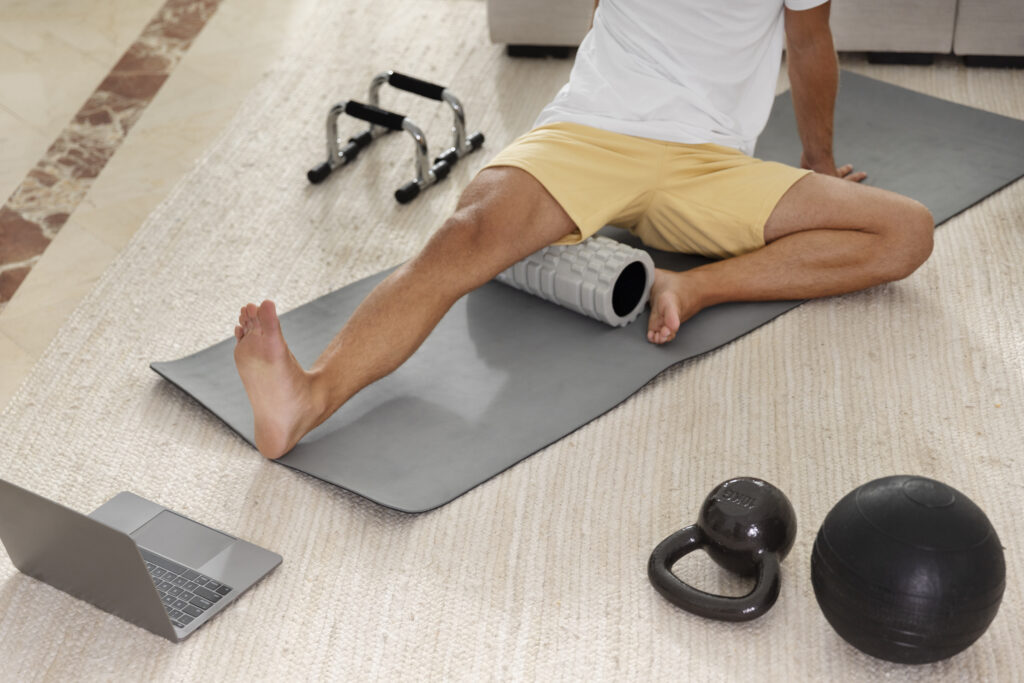
- Release: Use tools like a foam roller or lacrosse ball to inhibit overactive, tight muscles. This is technically known as self-myofascial release (SMR).
- Stretch: After releasing the muscle, perform static or dynamic stretches to lengthen it and improve the joint’s range of motion.
- Strengthen: Finally, perform activation exercises to strengthen the opposing, underactive muscles. This is what teaches your body to use the new range of motion and hold a better position.
Here are targeted routines for the three most common areas of pain.
Fixing shoulder pain (the desk-worker’s dilemma)
If your Wall Angel test was challenging, this routine is for you. It targets the classic causes of shoulder impingement: poor posture, tight pecs, and weak upper back muscles.
- 1. Release:
- Pec Minor Release: Place a lacrosse ball on your upper chest, just below the collarbone. Lean against a wall or doorframe and gently roll the ball around to find tender spots. Hold for 30 seconds.
- Lat Release: Lie on your side with a foam roller just below your armpit. Roll slowly up and down your side. 30-60 seconds per side.
- 2. Stretch:
- Doorway Pec Stretch: Stand in a doorway and place your forearms on the frame, elbows bent at 90 degrees. Step forward gently until you feel a stretch across your chest. Hold for 30-45 seconds.
- 3. Strengthen:
- Band Pull-Aparts: Hold a light resistance band with both hands, arms straight out in front of you. Squeezing your shoulder blades together, pull the band apart until it touches your chest. 2-3 sets of 15-20 reps.
- Face Pulls: Use a cable machine or a band attached to a high anchor point. Pull the rope or band towards your face, aiming to get your hands by your ears. Focus on external rotation and squeezing your rear delts and mid-traps. 2-3 sets of 12-15 reps.
Bulletproofing your knees (beyond ‘don’t let knees go over toes’)
If you saw your knee cave inward during the overhead or single-leg squat, this routine will help build the hip stability necessary to protect your knees.
- 1. Release:
- Quad/TFL Foam Roll: Lie face down with a foam roller under the front of your thigh. Roll from the bottom of your hip to the top of your knee. To hit the tensor fasciae latae (TFL), rotate your body slightly. 30-60 seconds per side.
- 2. Stretch:
- Kneeling Hip Flexor Stretch (Couch Stretch): In a lunge position with your back knee on the ground, place your back foot up on a bench or couch. Tuck your pelvis under (squeeze your glutes) to feel a deep stretch in the front of your hip. Hold for 45-60 seconds per side.
- 3. Strengthen:
- Glute Bridges: Lie on your back with your knees bent and feet flat on the floor. Drive through your heels and squeeze your glutes to lift your hips toward the ceiling. 2-3 sets of 15-20 reps.
- Clamshells: Lie on your side with your knees bent and stacked. Keeping your feet together, lift your top knee without rotating your pelvis. 2-3 sets of 20-25 reps per side.
Building a resilient back (your foundation for strength)
If your lower back arched during the overhead squat or you suffer from general low back ache, this routine focuses on improving core stability and glute activation—two keys to taking the stress off your spine.
- 1. Release:
- Glute/Piriformis Release: Sit on the floor and place a lacrosse ball under one glute. Cross that leg over the opposite knee to deepen the pressure. Roll gently to find tender spots. 30-60 seconds per side.
- 2. Stretch:
- Cat-Cow: On all fours, gently round your spine up toward the ceiling (cat), then arch it down toward the floor (cow). This mobilizes the entire spine. 10-12 slow cycles.
- 3. Strengthen:
- Bird-Dog: On all fours, engage your core. Extend your opposite arm and leg simultaneously without arching your back. Focus on stability. 2-3 sets of 10-12 reps per side.
- Dead Bug: Lie on your back with your arms extended toward the ceiling and your knees bent at 90 degrees over your hips. Slowly lower your opposite arm and leg toward the floor, keeping your lower back pressed into the ground. 2-3 sets of 10-12 reps per side.
Long-term integration: weaving pain-free principles into your workouts
Corrective exercises are powerful, but their true benefit comes when they become an integrated part of your training philosophy. The goal is not to do these routines forever, but to use them to build a body that no longer needs them.
Here is how to make pain-free training your new normal:
- Upgrade your warm-up: Ditch the 5 minutes of mindless cardio. Use a 10-15 minute dynamic warm-up that includes the release, stretch, and activation drills that target your specific weak points. This prepares your body for the exact movements you’re about to perform.
- Train around, not through, pain: If an exercise hurts, don’t just push through it. Find a pain-free alternative. Does barbell overhead press hurt your shoulder? Try a landmine press or a dumbbell neutral-grip press, which are often more shoulder-friendly. The goal is to find variations that allow you to train hard without causing irritation.
- Make prehab your accessory work: Instead of doing three different kinds of bicep curls, use one of those slots for face pulls, glute bridges, or bird-dogs. Prioritizing the small, stabilizing muscles pays huge dividends for your strength and longevity in the main lifts.
- Listen to your body’s signals: Learn the difference between the burn of muscle fatigue (good) and the sharp, pinching, or aching pain of a joint or connective tissue problem (bad). Productive training requires intensity, but it should never come at the cost of joint health. If you are ever in doubt, it is always best to consult a professional for guidance on physical therapy for sports injuries.
- Master the fundamentals of anatomy: Corrective exercise prepares the tissue, but proper strength training is what builds resilience. To prevent future injuries, you must ensure you aren’t neglecting critical areas or performing major lifts with poor understanding of muscle function. Use the Dubai Strength Training Blueprint: Master 11 Key Muscle Groups to deepen your knowledge of resistance training mechanics. Understanding exactly how each muscle group functions will help you select the best, most structurally sound exercises for your body.
Ready to apply these principles with expert guidance?
Your path to a resilient body
Recurring pain is not a required side effect of an active lifestyle. It’s a sign that your body’s foundation has cracks. By moving beyond temporary fixes and adopting a systematic approach, you can take control of your training and your health.
You now have a framework to understand the root causes of your pain, a toolkit to self-assess your movement, and an actionable plan to correct the imbalances holding you back. This isn’t a quick fix; it’s a fundamental shift in how you approach your training. A shift from reacting to injuries to proactively building a resilient, bulletproof body.
Ready to build your own resilient body? Start with one self-assessment this week and see what you discover. For a personalized plan to help you achieve your strength and performance goals without pain, learn more about our coaching programs.
This article is for informational purposes only and does not constitute medical advice. The author, a Sports Science graduate and corrective exercise specialist with over 15 years of experience, provides this information based on their expertise. Always consult with a qualified healthcare professional before beginning any new exercise program, especially if you have a pre-existing medical condition or injury.
Frequently asked questions
How do I know if I have joint pain or just muscle soreness?
Muscle soreness, or delayed onset muscle soreness (DOMS), typically feels like a dull, widespread ache in the muscle belly. It peaks 24-48 hours after a workout and gets better with light movement. Joint pain is often sharper, more localized to the joint itself (e.g., deep inside the shoulder, at the front of the knee), and tends to feel worse during or immediately after specific movements.
Can I do prehab exercises every day?
Yes, most prehab and corrective exercises are low-intensity and can be done daily. They work very well as part of a morning mobility routine or as a warm-up before every training session. Listen to your body and don’t push through any sharp pain.
What’s the single most important exercise for preventing injuries?
There is no single “best” exercise. Injury prevention is about balance and addressing your personal weak links. A balanced program that includes compound lifts, targeted accessory work for stability (like the exercises in this guide), and mobility work is far more effective than relying on one magic bullet exercise.
How long does it take for corrective exercise to work?
You may feel immediate relief in your range of motion after releasing and stretching. However, creating lasting change by strengthening underactive muscles and ingraining new movement patterns takes consistency. Most people notice a significant reduction in chronic pain and improved movement quality within 4-6 weeks of consistent application.
When should I see a doctor or physical therapist?
You should always consult a medical professional if you experience sharp, sudden pain, significant swelling or bruising, an inability to bear weight on a limb, or pain that doesn’t improve or worsens with time. This guide is a tool for managing chronic, movement-related aches, not for diagnosing or treating acute injuries.