
Does cardio kill gains? No, not if programmed correctly.
Short answer: Cardio does not kill gains when programmed with the right intensity, volume, and timing. Problems arise only when endurance work is excessive, high-impact, or poorly scheduled.
The fear that cardiovascular training is inherently catabolic is a myth. Decades of research confirm that while excessive endurance work can interfere with hypertrophy, a strategic approach known as Hybrid Training allows you to build an elite engine without sacrificing strength or size.
This fear is often described as the “ghost that haunts the weight room.” For decades, “bro science” has painted a picture of cardio as a catabolic monster, ready to devour hard-earned muscle at the first sign of a treadmill. But this fear is misplaced. The problem isn’t the cardio itself, but how most lifters mismanage the volume, timing, and intensity.
The solution is not to avoid cardio, but to program it with intelligence and precision. This is the science of hybrid training—the evidence-based methodology for achieving the best of both worlds. It’s how you can build an elite cardiovascular engine without sacrificing an ounce of strength or size.
This guide is your definitive, science-backed playbook to move beyond the myths. Drawing on over 15 years of experience rooted in sports science, I have crafted protocols that deliver real-world results for physique athletes. Forget the confusion; this is your actionable plan to enhance recovery, break through plateaus, and forge elite conditioning that supports, not sabotages, your gains.
The myth of ‘cardio kills gains’: understanding the interference effect
To program cardio effectively, we first need to understand the science behind the fear. The concern isn’t entirely baseless; it’s just misunderstood and poorly managed. The core of the issue lies in a concept known as the “interference effect.”
What is hybrid training?
Hybrid training is the strategic combination of resistance training (lifting) and endurance training (cardio) within the same program. For a lifter, the purpose isn’t to become a marathon runner; it’s to leverage specific cardio protocols to improve cardiovascular health, increase work capacity, and optimize body composition, all while protecting and even enhancing hypertrophy and strength goals.
The science explained: Ampk vs. mtor signaling pathways
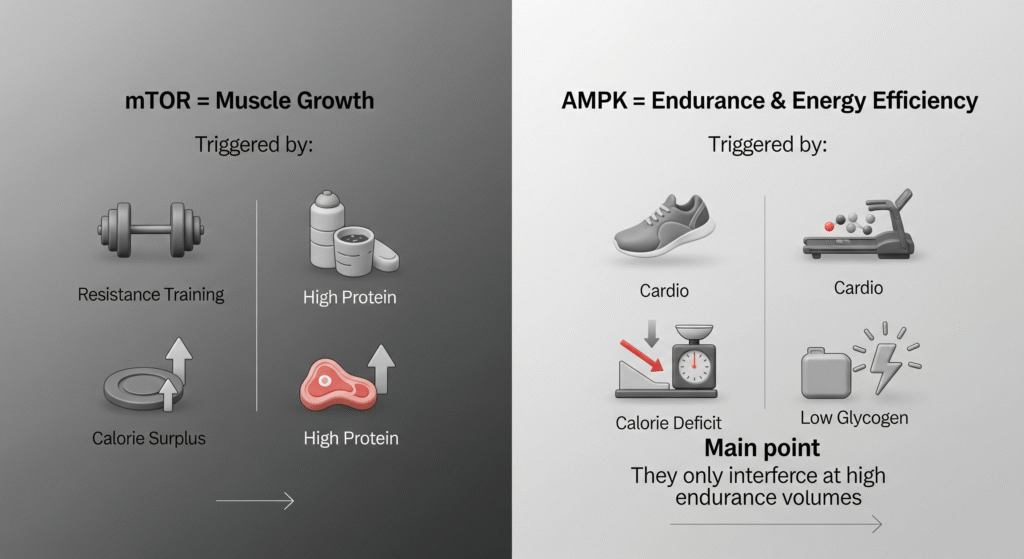
In simple terms, your body has two primary signaling pathways that tell your muscles how to adapt:
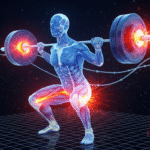
- mTOR (Mammalian Target of Rapamycin): This is the master regulator of muscle growth. When you lift weights, you activate mTOR, signaling your body to build bigger, stronger muscle fibers. Think of it as the “build muscle” signal.
- AMPK (AMP-activated protein kinase): This pathway is activated by endurance exercise. It signals the body to become more energy-efficient by building mitochondria and improving endurance. Think of it as the “build endurance” signal.
The “interference effect” theory stems from the fact that these two pathways can work against each other. High volumes of endurance training strongly activate AMPK, which can, in turn, inhibit the mTOR pathway. As the Gatorade Sports Science Institute explains, this molecular competition is the scientific basis for the fear that cardio will blunt the muscle-building response from lifting.
However, the key takeaway is that this effect is highly dependent on the type, volume, and timing of your training. With proper programming, it’s entirely manageable. So, when asking does cardio kill gains, the answer lies not in the activity itself, but in how you schedule it.
Practical takeaway: mTOR builds muscle and AMPK builds endurance — both can coexist when cardio is low-impact, moderate, and properly timed.
The verdict on ‘Does Cardio Kill Gains?’: What a 2022 meta-analysis reveals
While the molecular theory is interesting, what matters are real-world results. Fortunately, the science is overwhelmingly clear. A massive 2022 meta-analysis published by the National Institutes of Health (NIH) provided a definitive answer. After reviewing a vast body of research, this extensive scientific review on concurrent training concluded that when programmed correctly, skeletal muscle size and maximal strength are not compromised by concurrent training.
This is the nail in the coffin for the fear that keeps lifters off the treadmill. The data definitively answers the question: does cardio kill gains? No, not if the volume and intensity are managed correctly.
When cardio can hurt gains (and how to avoid it)
To build trust, we must be honest: improper cardio programming can interfere with your progress. The interference effect becomes a real problem when you make these common mistakes:
- Excessive volume: Performing extremely long-duration endurance sessions (e.g., 90+ minutes of running) creates a massive recovery demand and caloric deficit that can impair muscle growth.
- High-impact modalities: Chronic, long-distance running on hard surfaces generates significant muscular damage and stress, which can compete with the recovery resources needed for lifting.
- Poor timing: Performing intense or lengthy cardio immediately before a heavy lifting session can cause central nervous system fatigue and deplete glycogen stores, directly reducing your strength and performance in the weight room.
- Inadequate nutrition: Not eating enough calories and protein to fuel both lifting and cardio is the fastest way to become catabolic. You cannot expect to build or maintain muscle in a massive energy deficit.
The lifter’s cardio toolkit: choosing the right modality (liss vs. hiit vs. zone 2)
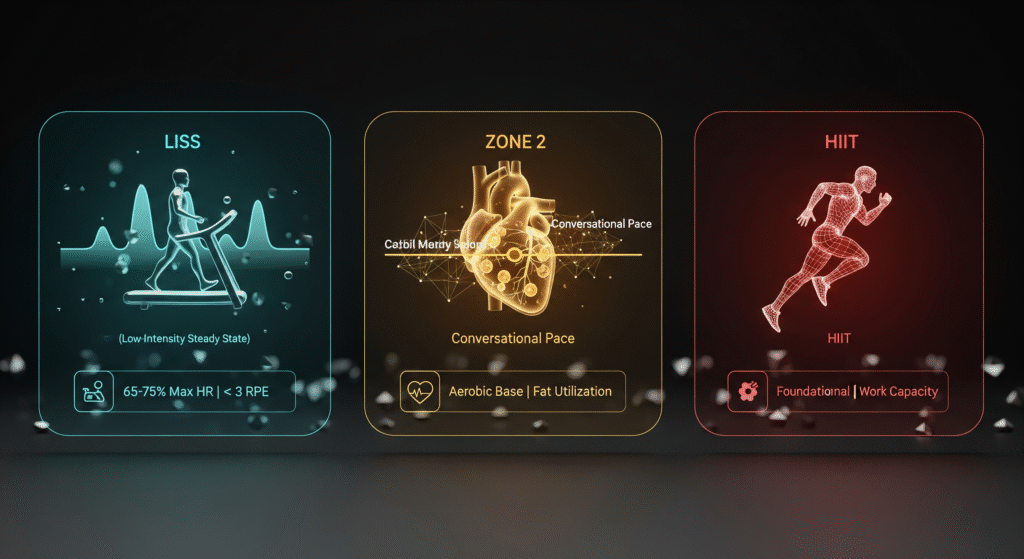
Cardio is not a monolith. Different types of cardiovascular training are different tools, each with a unique purpose, benefit, and impact on your recovery. For a lifter, choosing the right tool for the job is paramount.
Low-intensity steady-state (liss): your secret weapon for recovery
LISS is any form of low-intensity cardio performed at a steady pace for a set duration. Think of walking on an incline treadmill, light cycling, or using an elliptical where your heart rate stays relatively low.
- Primary benefits: LISS is a powerful tool for active recovery. It promotes blood flow to tired muscles, which helps deliver nutrients and clear out metabolic byproducts from your lifting sessions. It achieves this with minimal stress on your central nervous system (CNS), meaning it aids recovery without adding to your overall fatigue.
- When to use it: Use LISS on rest days as active recovery or as a 20-30 minute cool-down after a lifting session to kickstart the recovery process.
High-intensity interval training (hiit): maximum impact in minimum time
HIIT involves short bursts of all-out effort followed by brief recovery periods. Examples include sprint intervals on an assault bike, a rowing machine, or a SkiErg.
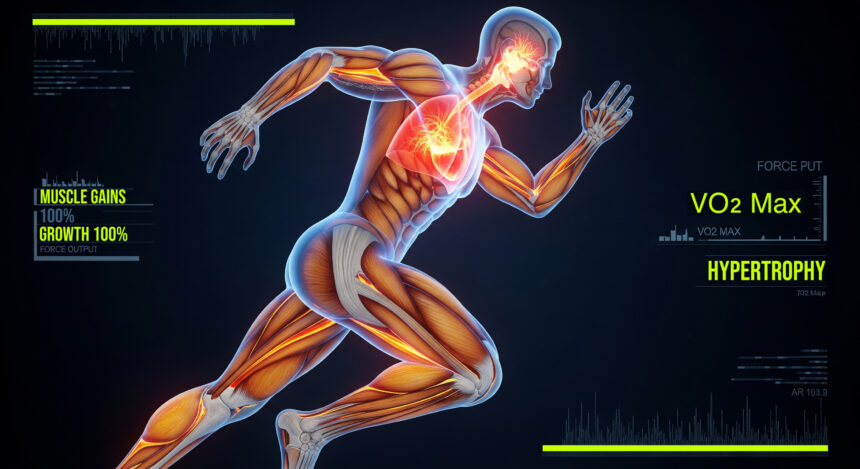
- Primary benefits: HIIT is incredibly time-efficient for improving cardiovascular fitness (VO2 max) and burning calories. Because it involves explosive, short-duration efforts, it can be more muscle-sparing than long-duration cardio by recruiting similar fast-twitch muscle fibers used in lifting.
- Cautions: HIIT is highly demanding on the CNS. Too much HIIT can quickly lead to overtraining and interfere with your recovery from lifting. It must be programmed sparingly and intelligently.
Zone 2 training: building your aerobic base for massive work capacity
Zone 2 refers to training at a “conversational pace,” which typically corresponds to 60-70% of your maximum heart rate. It’s an intensity where you could hold a full conversation without gasping for breath.
- Primary benefits: This is arguably the most valuable tool for any lifter. Zone 2 training builds mitochondrial density, which optimizes the Oxidative Energy System we discussed in Sports Science 101, allowing for faster ATP regeneration.”. The result is a massive increase in your work capacity, the ability to handle more volume in the gym, recover faster between sets, and perform high-rep sets without gassing out.
- The ‘why’: A bigger aerobic base means your heart can pump more oxygenated blood to your muscles with every beat. This allows you to recover more quickly between those brutal sets of squats or deadlifts, enabling you to lift more weight for more reps over time—a primary driver of muscle growth.
Which tool for which goal? a lifter’s decision guide
To ensure the answer to “does cardio kill gains” remains a firm “no,” you must match the right tool to your specific training phase. The right tool depends on your current goal. Here’s a simple framework:
| Modality | Intensity | Duration | CNS Impact | Best For (Goal) |
|---|---|---|---|---|
| LISS | Low | 30-60 min | Very Low | Active Recovery, Fat Loss (in a deficit), Stress Management |
| Zone 2 | Low-Mod | 30-60+ min | Low | Building Work Capacity, Improving Recovery, Overall Health (Bulking/Maint.) |
| HIIT | Very High | 10-20 min | Very High | Time-Efficient Conditioning, Calorie Expenditure (Cutting) |
- Bulking phase: Prioritize Zone 2 to build your work capacity, allowing you to handle more volume in your lifting. Add LISS for recovery. This combination improves your engine without creating a significant calorie deficit.
- Cutting phase: Use a strategic mix of all three. Employ 1-2 short HIIT sessions per week for time-efficient calorie burning and conditioning. Use Zone 2 and LISS on other days to increase energy expenditure without impeding recovery from lifting in a calorie deficit.
- Maintenance phase: Focus on Zone 2 training as the foundation of your cardio to maintain your aerobic base, overall health, and work capacity. Sprinkle in occasional HIIT sessions to maintain peak conditioning.
Structuring your week: practical concurrent training templates
Knowing the tools is one thing; organizing them into a coherent weekly schedule is another. The following templates integrate cardio into popular lifting splits, providing a clear path to success.
The golden rules of scheduling: timing and separation
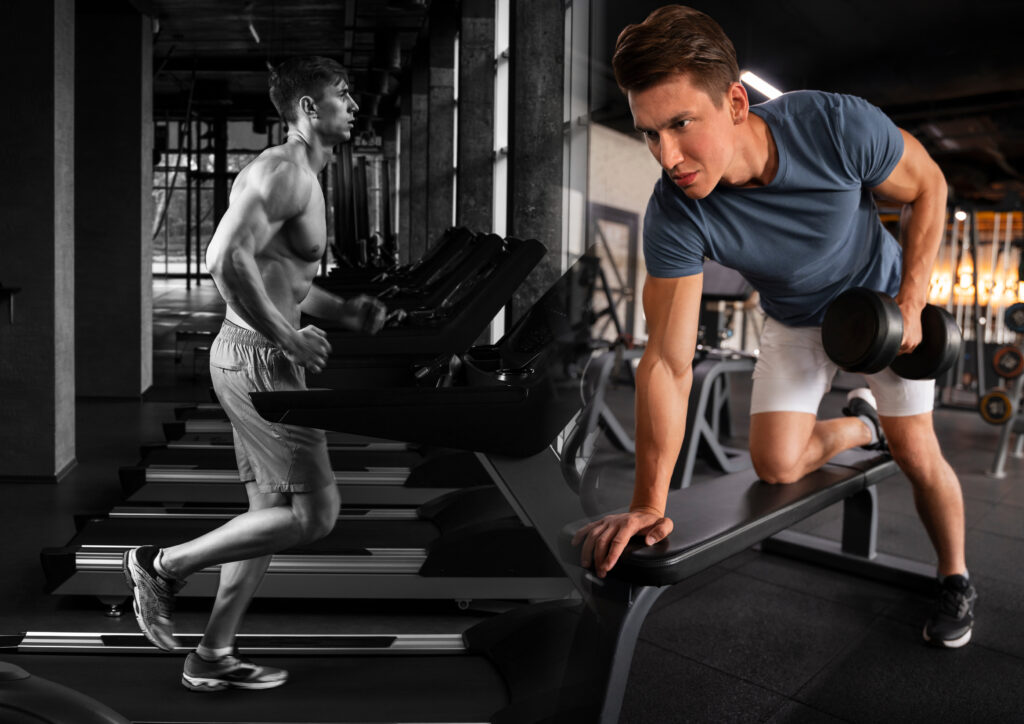
Before looking at the templates, internalize these three evidence-based rules:
- Separate when possible: The ideal scenario is to perform cardio and lifting on separate days. If you must do them on the same day, separate the sessions by at least 6 hours to allow molecular signaling pathways to operate without interference.
- Lift first: If you must perform both in the same session, always lift first. Performing endurance training before strength work can cause fatigue that significantly reduces your lifting performance. This is strongly supported by research on training sequence, which shows strength performance is better preserved when it’s done first.
- Match intensity: Pair high-intensity lifting days (like a heavy leg day) with low-intensity cardio (LISS). Conversely, you can pair a lower-intensity lifting day (like an arm day) with higher-intensity cardio (HIIT).
Sample template 1: concurrent training for a push-pull-legs (ppl) split
- Day 1: Push (Chest/Shoulders/Tris) + 20 min LISS post-workout (incline walk)
- Day 2: Pull (Back/Biceps)
- Day 3: Legs (Quads/Hams/Glutes)
- Day 4: Active Recovery (30-45 min Zone 2 on a stationary bike)
- Day 5: Push + 15 min HIIT (Assault Bike: 30s on, 30s off)
- Day 6: Pull
- Day 7: Rest or a dedicated 45-min Zone 2 session
Sample template 2: concurrent training for an upper/lower split
- Day 1: Upper Body Strength
- Day 2: Lower Body Strength
- Day 3: Active Recovery (30-45 min Zone 2 on a rower or elliptical)
- Day 4: Upper Body Hypertrophy + 20 min LISS post-workout
- Day 5: Lower Body Hypertrophy
- Day 6: HIIT Session (15 min SkiErg: 45s moderate, 15s sprint)
- Day 7: Rest
The synergy: how a strong engine boosts your lifting and physique
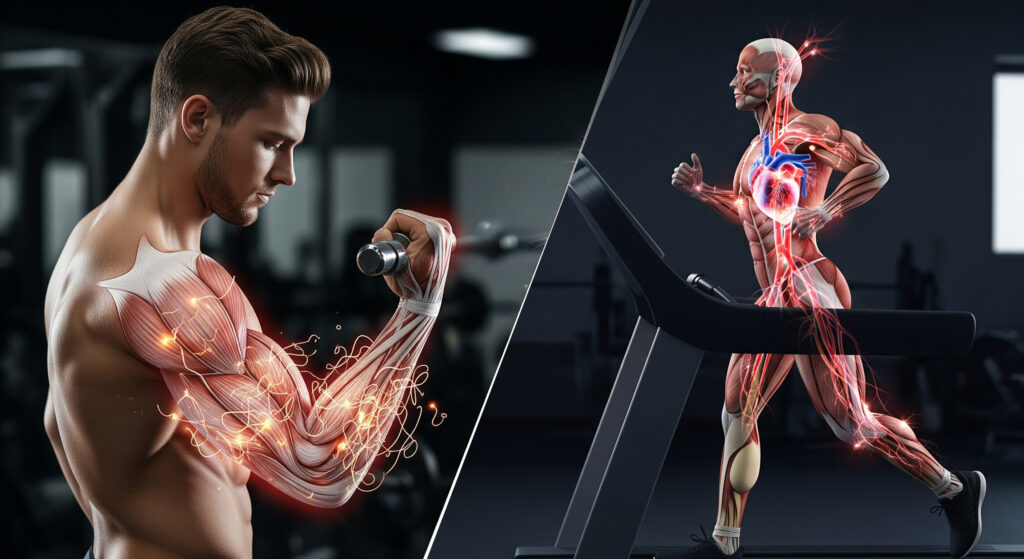
Intelligent cardio doesn’t just coexist with lifting; it actively enhances it. A well-developed aerobic system is one of the most powerful tools for accelerating your physique and strength goals.
Enhanced recovery: clear metabolic waste and reduce soreness
Low-intensity cardio like LISS and Zone 2 training increases blood flow throughout the body. This acts like a delivery service, transporting vital nutrients and oxygen to your muscles while simultaneously clearing out metabolic byproducts (like lactate) that accumulate during intense lifting. The result is reduced DOMS (Delayed Onset Muscle Soreness) and a body that’s better prepared and recovered for your next heavy session.
Increased work capacity: more reps, more sets, more growth
This is the number one benefit for any serious lifter. Your aerobic system determines how quickly you recover between sets. A stronger engine means your heart rate returns to baseline faster, allowing you to approach each set with more strength and focus. You’ll stop “gassing out” during high-rep sets of squats, leg presses, or rows. This improved work capacity allows you to handle more total training volume over time, which is the primary driver of gains according to our Scientific Guide to Muscle Hypertrophy.
Breaking through body composition plateaus
Stuck in a fat-loss rut? Instead of drastically slashing calories and sacrificing food volume, you can add strategic cardio sessions to increase your total weekly energy expenditure. This can restart fat loss without starving yourself. Similarly, improved conditioning can help you push through performance plateaus by allowing you to train with greater intensity and volume, triggering new muscle growth.
The longevity factor: why a big engine matters for big muscles
A massive chest is useless if the engine underneath is weak. It is important to realize that muscle tissue is metabolically expensive; carrying significant muscle mass places a higher demand on your cardiovascular system to pump blood and oxygen.
Heavy resistance training creates “pressure overload” on the heart, which tends to thicken the heart walls. While this shows strength, it needs to be balanced. Cardio creates “volume overload,” which helps expand the heart’s chambers and maintains its elasticity. Without this balance, the heart can become stiff and less efficient over time.
Cardiovascular training isn’t just about fat loss; it’s about ensuring your heart can support your physique for the long haul. For a deeper dive into training for longevity and managing factors like blood pressure, read my guide on Lifespan Fitness in Dubai.
Fueling the hybrid athlete: nutrition protocols for performance and muscle preservation
You cannot serve two masters—strength and endurance—on a starvation diet. Proper nutrition is the glue that holds a concurrent training program together and ensures you’re building muscle, not losing it.
Calorie and macro adjustments for concurrent training
- Energy is non-negotiable: You must fuel your efforts. Trying to perform intense lifting and regular cardio in an aggressive calorie deficit is a recipe for muscle loss, fatigue, and burnout.
- Fueling guidelines: First, calculate your maintenance calories for your lifting schedule. Then, add back 75-100% of the calories you burn during your dedicated cardio sessions. This ensures you have enough energy for performance and recovery.
- Protein: Keep protein intake high to support muscle protein synthesis and repair. A target of 1.6-2.2 grams of protein per kilogram of bodyweight is a well-supported range for strength athletes.
- Carbohydrates: Carbs are your high-performance fuel. Do not fear them. They are essential for replenishing the muscle glycogen that powers both your lifting and higher-intensity cardio sessions.
Peri-workout nutrition: fueling for two masters
Timing your nutrients around your workouts becomes even more critical when combining training modalities.
- Pre-workout: Consume a meal with easily digestible carbohydrates and some protein 60-90 minutes before your training session. This tops off your glycogen stores and ensures you have readily available energy.
- Intra-workout: For very long sessions (e.g., a 90-minute lift followed immediately by 30+ minutes of cardio), consider sipping on an intra-workout drink containing carbohydrates to maintain performance and prevent fatigue.
- Post-workout: This is a critical window. Consume a meal containing adequate protein (30-40g) and carbohydrates within two hours of finishing your entire training block. This will kickstart muscle repair and replenish depleted glycogen stores. For more detail, explore our guide to Performance Nutrition.
The importance of hydration and electrolytes
Even a slight level of dehydration, as little as 1-2% of your body weight can drastically impair both strength and endurance performance.
- Monitor your intake: Track your fluid intake throughout the day and monitor your urine color (aim for a pale yellow).
- Electrolytes are key: This is especially true for anyone training in the Dubai heat. Sweat doesn’t just contain water; it contains crucial electrolytes like sodium and potassium that are vital for muscle function. Adding an electrolyte powder to your water during and after training is a non-negotiable strategy for optimal performance and hydration.

Special considerations: concurrent training in the Dubai heat
As experts based in Dubai, we have first-hand experience in programming for the unique challenges of this environment. The heat is a non-negotiable factor that must be respected.
Why the heat is a non-negotiable factor
Training in a hot and humid climate places significantly more stress on your cardiovascular system. Your heart has to work harder to pump blood to both your working muscles and your skin for cooling. This leads to an increased heart rate, a higher sweat rate, and a greater demand on your body’s recovery systems. Ignoring this is a surefire way to under-recover and compromise your results.
Smart scheduling and indoor options
- Avoid peak heat: Never perform outdoor cardio during the peak heat of the day (roughly 10 am to 5 pm). Schedule outdoor sessions for the very early morning or late evening.
- Leverage indoor options: Dubai gyms are well-equipped with excellent low-impact cardio machines that are perfect for concurrent training. Prioritize these options:
- Incline Treadmills (for LISS/Zone 2)
- StairMasters or StepMills
- Stationary Bikes (Assault, Echo, or spin bikes)
- Rowing Machines
- SkiErgs
- Tower Stairwells: If you live in a high-rise in Dubai Marina, JLT, or Downtown, you have a “vertical gym” built into your building. Stair climbing is excellent for building glute endurance and cardiovascular health without the impact of running. Just ensure your building’s stairwell is ventilated before starting a long session.
Advanced hydration strategies for the UAE climate
“Drink more water” is not enough here.
- Pre-hydrate with electrolytes: Add an electrolyte powder or tablet to the water you drink in the hours leading up to your workout. This ensures you start your session with balanced mineral levels.
- Weigh yourself: For the most accurate hydration strategy, weigh yourself immediately before and after your training session. For every 1 kg of body weight lost, you should aim to replenish with 1.5 liters of fluid over the next few hours.
Conclusion: build your engine, build your body
So, does cardio kill gains? The myth that you must choose between having a great physique and having great conditioning is dead. When programmed with intelligence and fueled with proper nutrition, cardiovascular training is a powerful catalyst for better performance, faster recovery, and a more resilient, capable body.
Cardio can enhance muscle growth, strength, and recovery when programmed intelligently, using the right modality at the right time.
You now have the complete playbook. The key steps are simple:
- Understand the interference effect and manage it with smart scheduling and separation.
- Choose the right tool for the job—LISS for recovery, HIIT for intensity, and Zone 2 for building your engine.
- Fuel your body adequately to support the demands of both training styles.
It’s time to stop fearing the treadmill and start building a massive engine that supports, not sabotages, your hard-earned muscle. Go forward with confidence and build a body that is as strong and fit as it looks.
To further optimize your training, explore our scientific guide on mastering your biomechanics for peak performance.
Frequently asked questions
How much cardio should i do to lose fat but not muscle?
Start with 2-4 sessions per week. A great combination is 1-2 shorter HIIT sessions (15-20 mins) and 2 longer Zone 2 or LISS sessions (30-45 mins). Adjust this volume based on your personal recovery and fat loss progress. The goal is to create a moderate calorie deficit through activity without generating so much fatigue that your lifting performance suffers.
Is it better to do hiit or liss for bodybuilding?
Both are effective tools, but they serve different purposes. LISS and Zone 2 are generally better for managing recovery and building a foundational aerobic base, while HIIT is a time-efficient tool for peak conditioning and burning calories. The best approach for a bodybuilder is to use a combination of modalities. Think of Zone 2 as building the engine and LISS as your recovery tool. Use HIIT sparingly as a high-impact weapon, especially during a cutting phase.
Can zone 2 cardio help muscle growth?
Yes, indirectly but powerfully. Zone 2 cardio improves your work capacity, which allows you to handle more training volume (more sets and reps) in the gym and recover faster between those sets. Both of these factors are key drivers of long-term muscle growth.
It doesn’t build muscle directly, but it builds the cardiovascular foundation that allows you to train harder and more effectively in the weight room, which is what triggers hypertrophy.
Should i do cardio on leg day?
It is generally best to avoid intense cardio on leg day. However, a short, low-intensity session, like a 15-minute walk on the treadmill or a light cycle, can be beneficial as a cool-down to promote blood flow.
Heavy leg days are extremely taxing on both your muscular and nervous systems. Adding intense cardio on the same day can severely compromise recovery. If you absolutely must, choose a low-impact LISS modality and, ideally, separate it from your lifting by at least six hours.