


Key takeaways
This guide provides a complete framework for intermediate athletes to optimize their nutrition for peak performance. You will learn how to master macronutrients for your specific sport, implement strategic nutrient timing to maximize energy and recovery, apply advanced hydration protocols to prevent fatigue, and use tactical fueling strategies—like calorie and carb cycling—to break through frustrating performance plateaus. By the end, you will have an actionable plan to translate what’s on your plate into tangible results.
As a Sports Science graduate with over 15 years of experience helping dedicated athletes translate complex nutritional science into real-world results, I’ve seen one thing hold back progress more than anything else: a generic approach to nutrition. You can’t out-train a diet that isn’t specifically tuned to your performance goals. If you’re stuck in a rut, struggling with energy, or recovering too slowly, your fueling strategy is likely the missing link.
This guide is your playbook. We will move beyond the basics and give you a clear, actionable framework to optimize your diet for tangible gains in strength, endurance and recovery.
Mastering the building blocks: advanced macro and micronutrient strategies

To build a high-performance body, you need the right building materials. While most people understand what proteins, carbohydrates, and fats are, elite performance comes from understanding why and how much your body needs based on your training demands. The nutritional requirements for a powerlifter are fundamentally different from those of a marathon runner.
General recommendations often fall short. Instead, performance nutrition relies on precise calculations based on your body weight and sport. Strength athletes require higher protein for muscle repair, while endurance athletes need significantly more carbohydrates to fuel prolonged effort. Let’s break down the specifics.
Protein: the foundation of recovery and adaptation
Protein is the critical driver of muscle protein synthesis (MPS), the process your body uses to repair training-induced muscle damage that causes soreness (DOMS), a concept I break down in my guide to Pain-Free Training. For athletes, the goal is to keep MPS elevated throughout the day. According to the joint position stand on sports nutrition from the ACSM, a daily intake of 1.6-2.2 grams of protein per kilogram of body weight is optimal for most athletes.
To effectively stimulate MPS, each meal should contain enough of the amino acid leucine, which acts as the primary trigger for muscle growth. This “leucine threshold” is typically met by consuming 20-40 grams of high-quality protein in a single sitting.
High-quality protein sources:
| Food Source (100g serving) | Protein (grams) | Notes |
|---|---|---|
| Chicken Breast (cooked) | ~31g | Lean, complete amino acid profile |
| Whey Protein Isolate | ~80-90g | Fast-digesting, ideal for post-workout |
| Greek Yogurt (0% fat) | ~10g | Contains casein for slower digestion |
| Lentils (cooked) | ~9g | Excellent plant-based source, high in fiber |
| Tofu (firm) | ~17g | Complete plant-based protein |
Want to know exactly which foods hit this threshold? For a definitive list of the top sources and a deep dive into the biology of amino acids, read my guide on Protein 101: Definition, Functions & Best Sources.
Carbohydrates: your high-performance fuel source
Carbohydrates are the body’s preferred and most efficient fuel source for high-intensity exercise. When you consume carbs, your body stores them in your muscles and liver as glycogen. During intense training, your body breaks down this glycogen for energy. If your glycogen stores are low, you’ll experience fatigue, decreased power output, and a sharp drop in performance.
Carb needs vary dramatically based on activity.
- Strength Training: A daily intake of 3-5 grams of carbs per kilogram of body weight is sufficient to replenish glycogen used during lifting sessions.
- Endurance Events: Endurance athletes may need 8-12 grams of carbs per kilogram of body weight, especially during intense training blocks or when employing carb-loading strategies 2-3 days before a major event.
Strategically, simple carbs (like fruit or sports drinks) are best used immediately before or during a workout for quick energy. Complex carbs (like oats, quinoa, and sweet potatoes) are ideal for meals throughout the day to ensure your glycogen stores remain full.
Fats: supporting hormones and long-duration energy
Dietary fat has been unfairly villainized, but it is essential for athletic performance. Healthy fats are critical for producing hormones like testosterone, which plays a key role in muscle growth and recovery. They are also vital for absorbing fat-soluble vitamins (A, D, E, K) and reducing inflammation.
While carbs are the primary fuel for high-intensity work, fat is the main energy source during lower-intensity, long-duration exercise. Athletes should aim to get 20-30% of their total daily calories from fat. Focus on unsaturated sources to support overall health and performance.
- Omega-3s: Fatty fish (salmon, mackerel), walnuts, flaxseeds, chia seeds.
- Monounsaturated: Avocado, olive oil, almonds, cashews.
- Polyunsaturated: Sunflower seeds, soybean oil, walnuts.
Key micronutrients for preventing performance drops
Macros get all the attention, but micronutrient deficiencies are a silent performance killer.
- Iron: Essential for creating hemoglobin, which transports oxygen to your muscles. Low iron leads directly to fatigue and reduced aerobic capacity.
- Vitamin D & Calcium: This pair is crucial for bone health. Athletes, especially those in high-impact sports, are at a greater risk for stress fractures if their intake is inadequate.
- Magnesium & Zinc: These minerals are involved in hundreds of enzymatic reactions, including muscle contraction, energy production, and sleep regulation. Low levels can lead to cramping, poor recovery, and a weakened immune system.
The science of nutrient timing: what to eat before, during, and after training

You can be eating all the right foods, but if you time them incorrectly, you’re leaving performance on the table. Nutrient timing is about strategically consuming your meals and snacks around your training sessions to provide your body with the right fuel at the right time. This simple strategy can dramatically improve your energy levels, delay fatigue, and accelerate recovery.
Pre-workout nutrition: fueling for optimal energy and focus
The goal of a pre-workout meal is to top off your glycogen stores and provide a steady stream of energy without causing digestive distress.
- 1-3 hours before training: Consume a meal rich in complex carbohydrates with a moderate amount of protein. This gives your body enough time to digest and absorb the nutrients.
- Example: A bowl of oatmeal with berries and a scoop of protein powder, or a grilled chicken breast with a sweet potato.
- 30-60 minutes before training: If you’re short on time, a small, easily digestible snack is best. Focus on simple carbohydrates that can be quickly converted to energy.
- Example: A banana, a handful of Local Dates, or a rice cake with honey.
Intra-workout fueling: sustaining performance during long sessions
For most gym sessions under 90 minutes, intra-workout nutrition isn’t necessary if your pre-workout meal was adequate. However, for prolonged endurance events or exceptionally intense, long-duration weight training, fueling during the session is critical.
According to NCAA nutrition guidelines for athletes, the goal is to consume 30-60 grams of easily digestible carbohydrates per hour to maintain blood glucose levels and spare muscle glycogen. This is typically achieved with sports drinks, gels, or chews. For workouts in the heat that cause heavy sweating, these fuel sources should also contain electrolytes like sodium and potassium to aid hydration and prevent cramping.
Post-workout recovery: kickstarting muscle repair and glycogen replenishment
The post-workout period is all about recovery. The goal is to replenish the glycogen stores to fuel the three energy systems we discussed in Sports Science 101, and provide your muscles with the protein needed to repair and rebuild. While the concept of a 30-minute “anabolic window” has been shown to be more flexible than once believed, consuming a quality meal within 1-2 hours after training is a proven strategy to optimize recovery.
Aim for a meal with a carbohydrate-to-protein ratio of around 3:1 or 4:1. This combination has been shown to be most effective for promoting glycogen resynthesis and muscle protein synthesis.
- Example: A chocolate milk recovery shake, a chicken and rice bowl, or Greek yogurt with fruit and honey.
From my 15+ years of coaching, the single most common mistake I see athletes make is neglecting their post-workout carbohydrates. They’ll rush to drink a protein shake but forget that replenishing their energy stores is just as critical for being ready for the next day’s session. Don’t make that mistake.
Beyond water: advanced hydration and electrolyte protocols for peak performance
Fatigue is often the first sign of dehydration. Research shows that losing as little as 2% of your body weight in fluid can lead to a significant drop in performance, including reduced endurance, decreased power, and impaired cognitive function. Optimizing your hydration is one of the easiest and most effective ways to boost your energy.
The Dubai Humidity Factor:
This is especially critical in our climate. According to the Statistics Centre Abu Dhabi (SCAD), humidity levels in the summer often exceed 80%. This creates a dangerous physiological environment: the moisture in the air prevents your sweat from evaporating, which is your body’s primary cooling mechanism. As a result, your core temperature spikes significantly faster than in drier climates. In these conditions, electrolyte intake isn’t optional; it’s a safety requirement.
Calculating your individual hydration needs
A one-size-fits-all approach to hydration doesn’t work. The best way to personalize your fluid intake is to calculate your sweat rate.
- Weigh yourself nude immediately before a one-hour training session.
- Train for one hour, tracking any fluid you consume (e.g., 500ml of water).
- After training, towel dry and weigh yourself nude again.
- Calculation: (Pre-workout weight – Post-workout weight) + Fluid consumed during = Total fluid loss.
For example, if you lost 1 kg and drank 0.5 kg (500ml), your total sweat loss is 1.5 kg, meaning your sweat rate is 1.5 liters per hour. This gives you a precise target for fluid intake during similar training sessions. For more detailed protocols, USADA’s Guide to Fueling for Performance offers an excellent resource.
The critical role of electrolytes
When you sweat, you don’t just lose water; you lose critical electrolytes like sodium, potassium, and magnesium. These minerals are essential for maintaining fluid balance, enabling muscle contractions, and transmitting nerve impulses.
Drinking only plain water during long, intense exercise can lead to a dangerous condition called hyponatremia, where the sodium levels in your blood become dangerously diluted. For sessions lasting longer than 90 minutes or those involving heavy sweating, an electrolyte drink is superior to plain water.
A practical hydration strategy for training days

- Pre-hydration: Drink 500-600ml of fluid 2-3 hours before your workout and another 200-300ml about 20 minutes beforehand.
- During training: Aim to drink 200-300ml every 15-20 minutes, adjusting based on your calculated sweat rate.
- Post-training rehydration: Your goal is to replenish more than you lost. For every kilogram of body weight lost during training, you should aim to drink 1.5 liters of fluid over the next few hours.
The plateau-breaker’s playbook: nutritional strategies to smash through barriers
Hitting a plateau is the most frustrating experience for any dedicated athlete. You’re training hard, but your lifts are stalled, your times aren’t improving, and your progress has ground to a halt. This is where most generic nutrition guides fail. Breaking through requires advanced, tactical strategies that align your diet precisely with your training goals.
Are you actually eating enough? overcoming low energy availability
The most common reason for a performance plateau is simply not eating enough. When your calorie intake is too low to support your training demands and basic bodily functions, you enter a state of Low Energy Availability (LEA). LEA tanks your hormones, slows recovery, increases injury risk, and brings your progress to a screeching halt.
In my experience, one of the quickest ways to break a plateau is to strategically increase calorie intake. I once worked with a client, a competitive CrossFitter, who had been stuck for six months. She was afraid to eat more for fear of gaining “bad weight.” We gradually increased her daily intake by 300-400 calories, primarily from carbohydrates around her workouts. Within a month, she was hitting new personal records across all her major lifts. She hadn’t changed her training; she had simply given her body the fuel it needed to adapt and grow.
Strategic calorie and carb cycling for strength and body composition
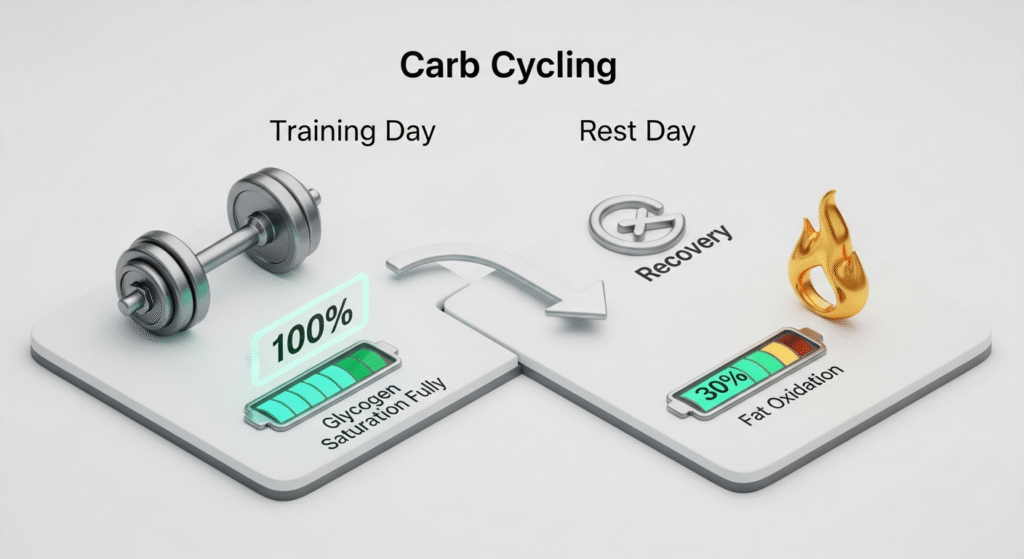
Carb cycling is the practice of aligning your carbohydrate intake with your training demands. On hard training days, you eat a high amount of carbohydrates to fuel performance and replenish glycogen. On rest days or light training days, you consume fewer carbohydrates.
This strategy can improve insulin sensitivity, making your body more efficient at using carbs for fuel and storing them as glycogen rather than fat. It’s an excellent tool for breaking through body composition plateaus while supporting high-intensity training.
Sample Weekly Carb Cycle (Strength Athlete):
- Monday (Heavy Squats): High Carb (5g/kg)
- Tuesday (Upper Body): Moderate Carb (3g/kg)
- Wednesday (Rest): Low Carb (1.5g/kg)
- Thursday (Heavy Deadlifts): High Carb (5g/kg)
- Friday (Accessory Work): Moderate Carb (3g/kg)
- Saturday (Active Recovery): Low Carb (1.5g/kg)
- Sunday (Rest): Low Carb (1.5g/kg)
Nutrient-periodization: aligning your diet with your training blocks
This is an advanced concept where you match your overall nutrition strategy to your current training phase.
- High-Volume/Hypertrophy Block: You need a sustained calorie surplus with high protein and moderate carbs to support muscle growth and recovery from the demanding workload.
- Strength/Peaking Block: Calorie intake might be closer to maintenance, but carbohydrate timing around workouts becomes critical to fuel maximal effort and heavy lifts.
- Deload Week: A slight caloric deficit can be used to improve body composition, but protein should remain high to preserve muscle. Reducing carbs in line with the reduced training volume can help maximize recovery and supercompensation for the next block.
Sometimes a performance plateau isn’t about food—it’s about training volume. Check out our Mastering Progressive Overload: The Science of Periodization & Continuous Growth to ensure your programming isn’t the bottleneck.
Strategic supplementation: separating the essential from the hype

A “food first” philosophy should always be your foundation. No supplement can replace a poor diet. However, a few select, well-researched supplements can provide a proven performance edge when used correctly. The key is to be strategic and avoid the industry hype.
Tier 1: proven performers
These are the supplements with extensive scientific backing for safety and efficacy.
- Creatine Monohydrate: The most studied sports supplement on the market. It increases your muscles’ stores of phosphocreatine, allowing you to produce more energy during short, explosive efforts. Standard dose is 3-5 grams daily.
- Caffeine: A powerful central nervous system stimulant that can reduce your perception of effort, making hard workouts feel easier. Typically effective at doses of 3-6 mg per kilogram of body weight, taken 60 minutes before exercise.
- Whey/Casein Protein: A convenient and high-quality way to help you meet your daily protein targets, especially useful for post-workout recovery shakes.
- Beta-Alanine: Buffers acid in your muscles during high-intensity exercise lasting 1-4 minutes, helping to delay fatigue. Requires a “loading” phase and is known for causing a harmless tingling sensation called paresthesia.
Tier 2: promising but context-dependent
These supplements have good evidence but may only be beneficial in specific scenarios.
- Nitrate (from Beetroot Juice): Can improve endurance performance by increasing blood flow and improving the efficiency of oxygen use. Most beneficial for events lasting 5-30 minutes.
- Citrulline Malate: May help reduce muscle soreness and fatigue during strength training by improving blood flow and helping to clear ammonia from the blood.
How to choose safe and effective supplements
The supplement industry is poorly regulated. To ensure the product you’re buying is safe and actually contains what it says on the label, always look for a third-party certification seal like NSF Certified for Sport or Informed-Sport. This is a non-negotiable step for any serious athlete and builds significant trust that you are consuming a pure, effective product.
Fueling in practice: sample meal plans for strength and endurance goals
Theory is useless without application. To bring these concepts to life, here are two sample daily meal plans designed for a ~80kg (176lb) athlete, one focused on strength training and the other on endurance. These are templates that you can adjust based on your specific calorie needs, schedule, and food preferences.
Sample day of eating for a strength/power athlete
- Calories: ~3,000 kcal
- Macros: ~200g Protein, ~330g Carbs, ~90g Fat
| Meal | Time | Foods |
|---|---|---|
| Meal 1 | 8:00 AM | 4 whole eggs, scrambled; 2 slices whole-wheat toast; 1 avocado |
| Meal 2 | 12:00 PM | 200g grilled chicken breast; 1.5 cups quinoa; 2 cups mixed vegetables with olive oil |
| Pre-Workout | 4:30 PM | 1 large banana; 1 scoop (30g) whey protein mixed with water |
| Workout | 5:00 PM – 6:30 PM | |
| Post-Workout | 7:00 PM | 200g lean ground beef; 1 large sweet potato; 1 cup broccoli |
| Meal 4 | 9:30 PM | 1.5 cups Greek yogurt (0% fat); 1/2 cup berries; 1 oz almonds |
Sample day of eating for an endurance athlete
- Calories: ~3,200 kcal
- Macros: ~170g Protein, ~450g Carbs, ~80g Fat
| Meal | Time | Foods |
|---|---|---|
| Pre-Run | 6:00 AM | 1 large bowl of oatmeal made with milk; 1 sliced banana; 1 tbsp honey |
| Workout | 7:00 AM – 9:00 AM | Long Run with 1 energy gel every 45 mins |
| Post-Run | 9:30 AM | Recovery smoothie: 1.5 scoops whey protein, 1 cup milk, 1 cup frozen berries, 1/2 cup spinach, 1/2 cup oats |
| Meal 2 | 12:30 PM | Large whole-wheat wrap with 150g sliced turkey, hummus, and lots of vegetables; 1 apple |
| Meal 3 | 4:00 PM | 1 cup cottage cheese with pineapple chunks |
| Meal 4 | 7:30 PM | 180g baked salmon; 2 cups brown rice; large salad with vinaigrette |
Easy food swaps and meal prep fundamentals
- Protein Swaps: Chicken breast can be swapped for turkey, fish, lean beef, or tofu.
- Carb Swaps: Quinoa can be swapped for brown rice, sweet potatoes, whole-wheat pasta, or oats.
- Fat Swaps: Avocado can be swapped for a serving of nuts, seeds, or olive oil.
Meal Prep Fundamentals:
- Cook in Bulk: Cook large batches of staple foods like chicken, rice, and roasted vegetables 2-3 times a week.
- Portion Immediately: As soon as the food is cooked, portion it into individual meal containers.
- Use a Slow Cooker: It’s an effortless way to prepare large batches of shredded chicken, beef, or stews.
- Prep Snacks: Portion out nuts, fruits, and yogurt into grab-and-go containers.
- Keep it Simple: You don’t need a different gourmet meal every day. Find 3-4 meals you enjoy and rotate them.
Ready to apply these principles with expert guidance?
Conclusion: from information to transformation
Unlocking your true athletic potential requires moving beyond generic advice and adopting a strategic, purposeful approach to nutrition. By mastering your macronutrients, nailing your nutrient timing, optimizing your hydration, and using targeted strategies to break through plateaus, you give your body the precise tools it needs to perform, recover, and adapt. Nutrition is no longer a passive afterthought; it becomes an active part of your training—the key to unlocking the next level of your performance.
Frequently asked questions about nutrition for performance
What are the best macros for an athlete?
The best macros for an athlete depend on their sport and goals, but a general starting point is 1.6-2.2g of protein per kg of body weight, 3-8g of carbs per kg, and 20-30% of total calories from fat. A strength athlete would typically be at the higher end of the protein range and the lower end of the carb range, while an endurance athlete would be the opposite.
What should I eat 30 minutes before a workout?
30 minutes before a workout, you should eat a small, easily digestible snack rich in simple carbohydrates, such as a banana, a handful of dates, or a sports gel. You should avoid significant amounts of fat, fiber, and even protein this close to a workout, as they slow digestion and can cause stomach discomfort during training.
How important is post-workout nutrition if I miss the ‘anabolic window’?
Post-workout nutrition is very important for recovery, but the ‘anabolic window’ is more flexible than once thought; consuming a quality meal within 1-2 hours after training is sufficient for most athletes. The priority is hitting your total daily protein and carbohydrate targets. Consistency over 24 hours is far more important than stressing about a single 30-minute window.
Can I build muscle on a plant-based diet?
Yes, you can absolutely build muscle on a plant-based diet by ensuring you consume enough total protein from a variety of sources to get a complete amino acid profile. Focus on combining sources like lentils, beans, tofu, tempeh, and quinoa. Supplementing with a high-quality vegan protein powder can also be a convenient way to meet your daily protein goals.
References
- Academy of Nutrition and Dietetics (AND), Dietitians of Canada (DC), and American College of Sports Medicine (ACSM). (2016). Position of the Academy of Nutrition and Dietetics, Dietitians of Canada, and the American College of Sports Medicine: Nutrition and Athletic Performance. Journal of the Academy of Nutrition and Dietetics, 116(3), 501-528.
- National Collegiate Athletic Association (NCAA). (n.d.). Nutrition and Performance Resources. Retrieved from https://www.ncaa.org/sports/2013/11/22/nutrition-and-performance-resources.aspx
- U.S. Anti-Doping Agency (USADA). (n.d.). Nutrition Guide: Fueling for Performance. Retrieved from https://www.usada.org/wp-content/uploads/Nutrition-Guide.pdf
- U.S. Department of Agriculture (USDA), National Agricultural Library. (n.d.). Fitness and Sports Nutrition. Retrieved from https://www.nal.usda.gov/human-nutrition-and-food-safety/fitness-sports-nutrition