


It’s a familiar story. You start a new workout routine filled with energy and determination. For a week, maybe two, you’re unstoppable. Then, a busy day hits. You’re tired. You skip one session. Soon, one skipped session becomes a week, and the guilt sets in. You blame your lack of willpower and wonder why you can’t just stay motivated.
If this sounds familiar, it’s because you’ve been sold a lie. The idea that you need more willpower to build a fitness habit is the single biggest myth in health and fitness.
This article is your official playbook to replace that myth with a proven, science-backed system. I’m Abooyeah Fitness Trainer, and as a sports science graduate with over 15 years of experience helping people overcome these exact mental barriers, I can tell you that lasting motivation isn’t about brute force. It’s about smart strategy.
In this guide, you will learn to stop fighting against your brain and start working with it. We’ll explore the real psychology of motivation, master the science of habit formation, and build a practical, sustainable workout routine from the ground up, one that runs on autopilot, not willpower.
Why your willpower is failing you: the psychology of motivation
Before we can build a new system, we have to understand why the old one, relying on sheer grit is designed to fail. The problem isn’t your discipline; it’s your strategy.
The willpower myth: why relying on discipline is a losing battle

Think of willpower as a battery. Every decision you make throughout the day, from choosing what to eat for breakfast to navigating a stressful meeting, drains a little bit of its power. By the time you need to decide whether to go to the gym, your battery is often running on empty. Relying on a finite resource for a long-term goal is a losing battle.
In my 15+ years as a trainer, the most common roadblock I see is clients blaming themselves for a lack of willpower. But science tells us that’s not the real problem. The issue isn’t a personal failing; it’s that you’re using a flawed and unreliable tool for the job. It’s time to stop feeling guilty and start building a system that doesn’t depend on how you feel in the moment.
Intrinsic vs. extrinsic motivation: finding your ‘why’
Motivation comes in two flavors: extrinsic and intrinsic.
- Extrinsic motivation comes from external factors, like exercising to lose weight for a wedding, to please a doctor, or to earn a reward. These motivators can be powerful in the short term, but they rarely last.
- Intrinsic motivation comes from within. It’s exercising because you genuinely enjoy the feeling of movement, the mental clarity it provides, or the sense of accomplishment you get from it. This is the bedrock of a lifelong habit.
According to extensive research in Self-Determination Theory, intrinsic motivation is fueled by three key psychological needs: autonomy (feeling in control), competence (feeling capable), and relatedness (feeling connected). As we’ll see, the science of exercise motivation shows that building a routine that satisfies these needs is far more effective than chasing external goals.
Moving from ‘have to’ to ‘want to’ exercise
To build a habit that sticks, you need to find your intrinsic “why.” This requires shifting your focus from an outcome you have to achieve to a feeling you want to experience.
Grab a journal and ask yourself these questions:
- How do I feel physically and mentally after I exercise? (e.g., energized, less stressed, accomplished)
- What mental clarity or creative ideas does movement give me?
- Which types of movement have ever felt like play to me, now or in the past?
This reflection helps you connect exercise to immediate, positive feelings, which are far more powerful drivers than a distant goal on the horizon.
| Extrinsic Motivators (Less Sustainable) | Intrinsic Motivators (More Sustainable) |
|---|---|
| “I need to get a beach body.” | “I love the feeling of strength and capability.” |
| “My doctor told me I have to.” | “Exercise is my dedicated time to de-stress.” |
| “I want to fit into my old jeans.” | “I have more energy to play with my kids.” |
| “I feel guilty if I don’t.” | “I enjoy the sense of accomplishment after a workout.” |
The science of habit formation: building your workout on autopilot
If willpower is the wrong tool, what’s the right one? A system. Specifically, a system based on the science of how our brains actually form habits. The most effective framework for this is the four-step model popularized by James Clear in Atomic Habits.
Introducing the habit loop: cue, craving, response, reward
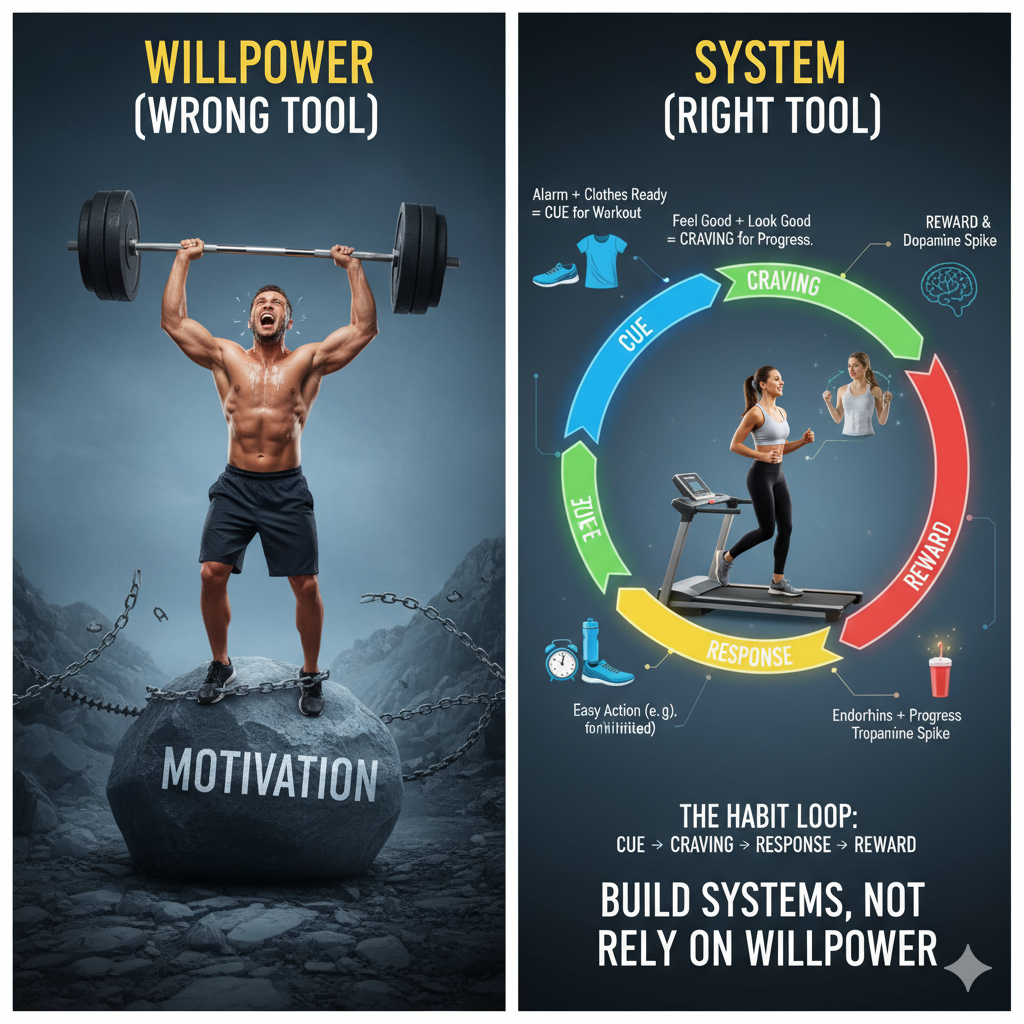
Every habit, good or bad, follows a simple neurological loop:
- Cue: The trigger that tells your brain to initiate a behavior. (e.g., Your alarm clock goes off.)
- Craving: The motivational force behind the habit. You aren’t craving the action itself, but the outcome it delivers. (e.g., The feeling of being awake and alert.)
- Response: The actual habit you perform. (e.g., You make a cup of coffee.)
- Reward: The satisfying outcome that teaches your brain the loop is worth remembering for the future. (e.g., The energy boost from the caffeine.)
To build a workout habit, we don’t fight this loop; we engineer it to work for us. This is the key to mastering atomic habits fitness and putting your routine on autopilot.
Law 1: make it obvious (the power of cues)
You can’t act on a habit that isn’t triggered. Instead of waiting for motivation to strike, create obvious, unmissable cues.
- Actionable Tactic 1 (Habit Stacking): Anchor your new workout habit to an existing one. The formula is: “After [Current Habit], I will [New Habit].”
- Example: “After I take off my work shoes, I will immediately change into my workout clothes.”
- Actionable Tactic 2 (Environment Design): Prime your environment to make the cue impossible to ignore.
- Example: Lay out your workout clothes, shoes, water bottle, and headphones the night before. Pack your gym bag and leave it by the front door. These are simple but powerful beginners fitness tips that automate your start.
Law 2: make it attractive (harnessing temptation)
If a habit is enjoyable, you’ll be more likely to do it.
- Actionable Tactic 1 (Temptation Bundling): Pair an action you want to do with an action you need to do.
- Example: “I will only listen to my favorite true-crime podcast while I’m out for a walk,” or “I’ll only watch my favorite Netflix show while I’m on the stationary bike.”
- Actionable Tactic 2 (Find Enjoyment): The best form of exercise is the one you’ll actually do. Stop forcing yourself to run if you hate it. Explore different activities—dancing, hiking, team sports, martial arts, rock climbing—until you find something that feels less like a chore and more like play.
Law 3: make it easy (the path of least resistance)
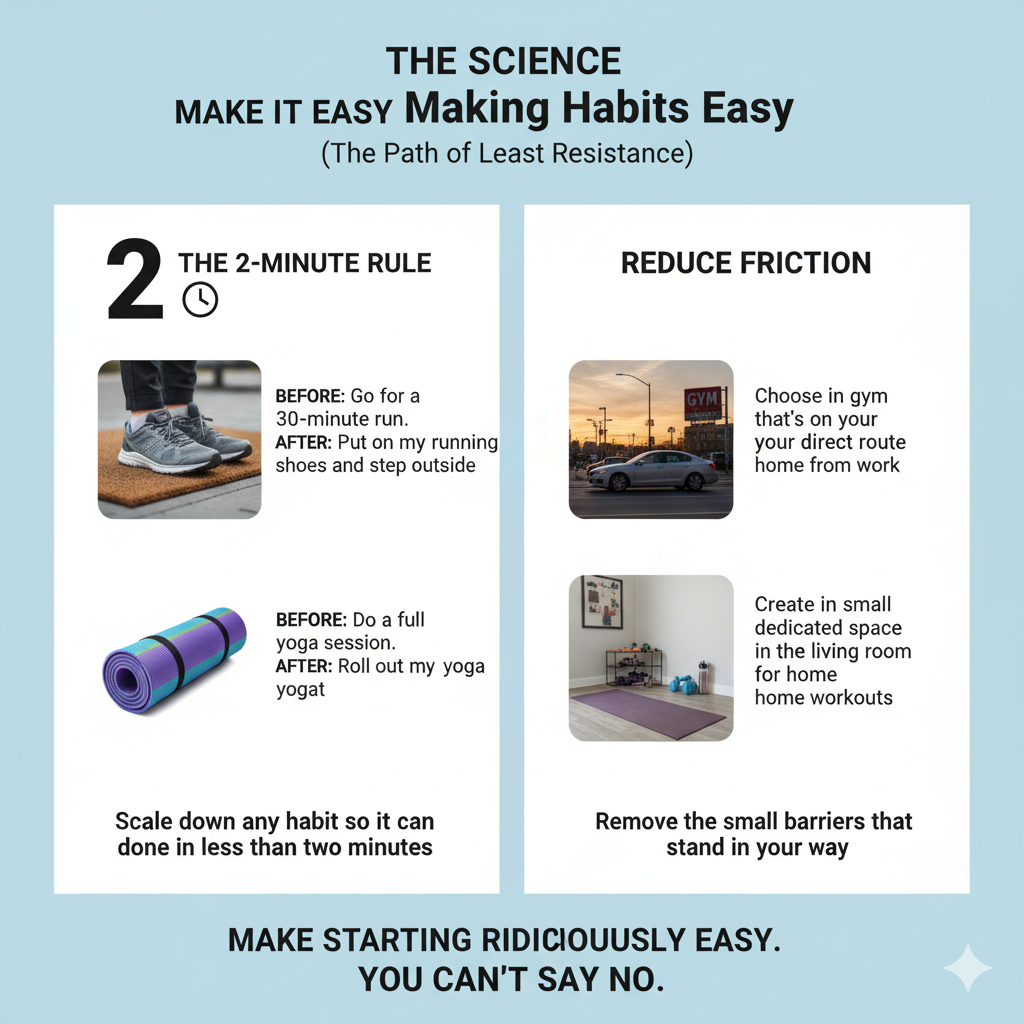
The more friction there is between you and a habit, the less likely you are to do it, especially when your willpower battery is low. The goal is to make starting ridiculously easy.
- Actionable Tactic 1 (The 2-Minute Rule): Scale down any habit so it can be done in less than two minutes.
- “Go for a 30-minute run” becomes “Put on my running shoes and step outside.”
- “Do a full yoga session” becomes “Roll out my yoga mat.”
- This strategy directly targets the struggle starting workout pain point by making it so easy to begin that you can’t say no.
- Actionable Tactic 2 (Reduce Friction): Remove the small barriers that stand in your way.
- Example: Choose a gym that’s on your direct route home from work. Create a small, dedicated space in your living room for home workouts.
I often advise clients who are overwhelmed by a 30-minute workout to just commit to the 2-minute version. Inevitably, once they start, they often do more. The magic of the 2-Minute Rule is that it masters the art of showing up.
Law 4: make it satisfying (creating a positive feedback loop)
Your brain is wired to repeat behaviors that have a satisfying ending. The problem with exercise is that many of its rewards (weight loss, muscle gain) are delayed. You need to create an immediate reward.
- Actionable Tactic 1 (Immediate Reinforcement): Give yourself a small, immediate reward after you finish your workout. This could be a delicious protein smoothie, five minutes of quiet meditation, or listening to a favorite song. The reward signals to your brain: “That was good. Let’s do it again.”
- Actionable Tactic 2 (Habit Tracking): The simple act of tracking your progress is a form of immediate satisfaction. Get a calendar and mark a big ‘X’ on every day you complete your workout. This creates a visual record of your streak and you won’t want to break the chain.
How long does it really take to form a habit?
You’ve probably heard the myth that it takes 21 days to form a habit. The reality is far more variable. Recent research shows there is no magic number; how long it takes to form a habit depends on the individual, the behavior, and the circumstances. Instead of focusing on a specific timeline, focus on consistency. Every time you perform your workout, you are strengthening the neural circuits and casting a vote for your new identity.
Designing your sustainable routine: a practical step-by-step guide
Knowing the science is one thing; applying it is another. Here is a step-by-step guide to building your personal workout system.
Step 1: define your ‘what’ with S.M.A.R.T. goals
Vague goals like “get fit” lead to vague actions. Instead, use the S.M.A.R.T. framework to create clarity and focus.
- Specific: What exactly do you want to achieve? (Not “get stronger,” but “do 10 push-ups.”)
- Measurable: How will you track your progress? (“Walk for 20 minutes.”)
- Achievable: Is this goal realistic for you right now? (Start with a 10-minute walk, not a marathon.)
- Relevant: Does this goal align with your intrinsic “why”?
- Time-bound: When will you achieve this by? (“I will be able to do 10 push-ups in 6 weeks.”)
Using S.M.A.R.T. goals is a proven method for overcoming motivational roadblocks because it transforms a fuzzy desire into a concrete plan of action.
Step 2: start ridiculously small
Using the 2-Minute Rule, define a “starter” routine that is too easy to fail. The goal of the first few weeks is not to transform your body; it’s to master the art of consistency.
- Example Week 1 Goal: After I brush my teeth in the morning, I will do 5 minutes of stretching in the living room.
- Example Week 2 Goal: After stretching, I will add a 10-minute walk around the block.
Once you’ve mastered the habit of showing up, you can gradually increase the duration and intensity. This approach prevents the burnout that dooms most new routines and can eventually lead to more structured plans, like an 8-week beginner fat loss program.
Step 3: schedule it like a non-negotiable appointment
If your workout is optional, it will always lose to “I’m busy.” Open your calendar right now and block out time for your exercise sessions for the next week. Treat it like a critical doctor’s appointment or a meeting with your boss. This removes the need for in-the-moment decision-making, which is a major drain on willpower.
This is the number one strategy I use with busy professionals in Dubai to ensure they stay consistent. When it’s in the calendar, it’s real.
Step 4: create your ‘workout menu’
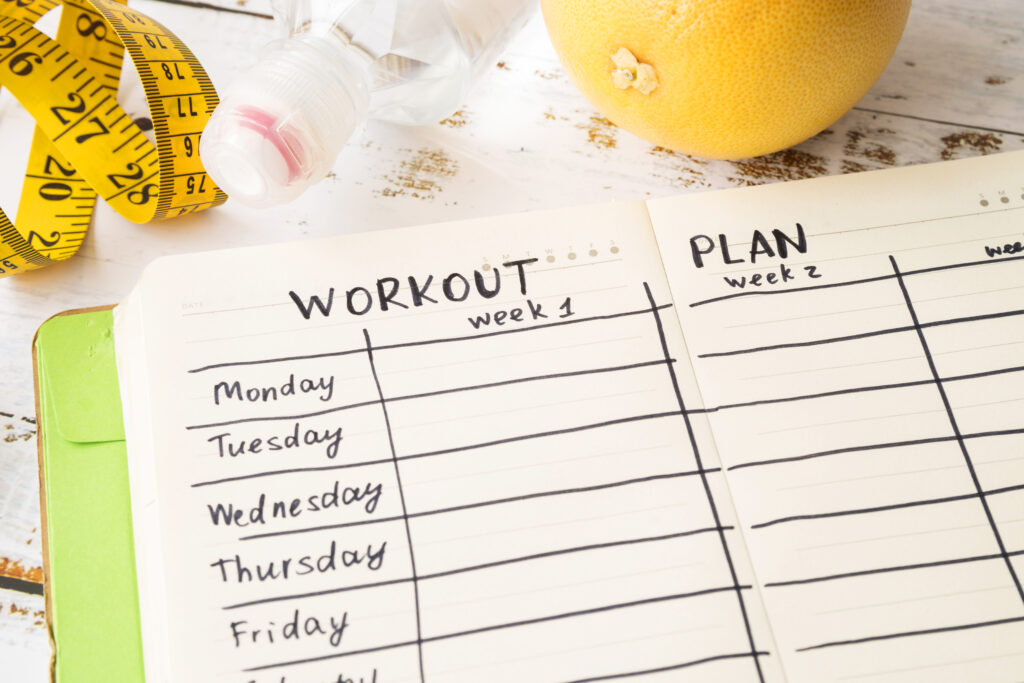
To combat boredom and give yourself flexibility, create a “menu” of workout options you enjoy, categorized by time. This empowers you with choice and helps you adapt to your daily energy levels.
- The 15-Minute Menu (For busy days):
- 15-minute brisk walk
- 10-minute bodyweight circuit (squats, push-ups, planks)
- 15-minute yoga/stretching video
- The 30-Minute Menu (Standard session):
- 30-minute gym session (weights or cardio)
- 30-minute jog or bike ride
- A group fitness class
- The 60-Minute Menu (For when you have more time & energy):
- A long hike
- A full sports game (tennis, basketball)
- A longer, more intensive workout
When it’s time to exercise, you just have to ask yourself, “What do I feel like ordering from the menu today?”
Overcoming the inevitable: how to troubleshoot your motivation dips
Even with the best system, there will be days when you don’t feel like it. The difference is having a plan to handle these barriers instead of letting them derail you.
The ‘i don’t have time’ barrier
- The Fix: Reframe your thinking. “Any movement is better than no movement.” Ditch the “all-or-nothing” mindset that says a workout is only valid if it’s 60 minutes long. Use your “Workout Menu” and pick a 15-minute option. Even 5 minutes of squats while your coffee brews is a win.
The ‘i’m too tired’ barrier
- The Fix: Acknowledge the paradox: light to moderate exercise almost always increases your energy levels. Apply the 2-Minute Rule. Commit to just two minutes of gentle movement, like stretching or walking. Give yourself full permission to stop after two minutes if you still feel exhausted. Nine times out of ten, you’ll find the momentum to continue.
The ‘i missed a day, now i’ve failed’ barrier
- The Fix: Embrace the rule: Never miss twice. Missing one workout is an accident. Missing two is the start of a new, undesirable habit. The goal is not perfection; it’s consistency. If you miss a Monday, you simply get back on track Tuesday. This single rule prevents a small slip-up from spiraling into a complete halt.
The ‘i’m bored with my routine’ barrier
- The Fix: This is a signal that it’s time for variety. Revisit your “Workout Menu” and try something new. Explore a different park, sign up for a trial class, or invite a friend to join you. As experts at the American Council on Exercise note, variety is a key component to help you make exercise a regular habit.
Leveraging the mind-body connection for unstoppable motivation
Your mindset is just as important as your system. These mental shifts can transform your relationship with exercise.
Focus on how exercise makes you feel, not just how it makes you look
Shift your focus to the immediate, tangible mental benefits of exercise. Pay attention to how a workout reduces your anxiety, boosts your mood, gives you a sense of accomplishment, and improves your sleep that very same day. These intrinsic rewards are far more powerful and immediate than waiting for the number on the scale to change.
Practice mindfulness to make exercise more enjoyable
Instead of distracting yourself with TV, try tuning in. Pay attention to the physical sensations of movement—the rhythm of your breath, the feeling of your muscles working, the solid contact of your feet on the ground. This can transform exercise from a chore you endure into a form of active meditation you look forward to.
Use visualization to break through mental blocks
Before your workout, take 60 seconds to visualize it. Imagine yourself moving with strength and energy. Picture how proud and accomplished you’ll feel when you’re done. This mental rehearsal primes your brain for action and can make the act of starting significantly easier.
Beyond the start: tracking progress and making it last for life
Once you’ve built the initial habit, the key is to maintain momentum for the long haul.
Why you need to track more than just the scale
The scale is a fickle and often demotivating measure of progress. To maintain a sense of accomplishment, especially during plateaus, track your “non-scale victories.”
- Increased energy levels throughout the day
- Clothes fitting better or feeling looser
- Lifting heavier weights or doing more reps
- Running faster or for longer without stopping
- Improved mood and reduced stress levels
- Better quality of sleep
The power of a progress journal
A simple weekly journal can reinforce your habit loop and provide invaluable data for troubleshooting. At the end of each week, jot down:
- Workouts completed: (e.g., 3/3 sessions)
- How I felt: (e.g., “Energized after my walks, tired but proud after the gym.”)
- A non-scale victory this week: (e.g., “I took the stairs without getting winded.”)
- A challenge I faced: (e.g., “I almost skipped Wednesday’s workout but used the 2-minute rule.”)
Gradually increasing the challenge (progressive overload)
To keep making progress and avoid boredom, you need to slowly increase the difficulty of your workouts. This is the principle of progressive overload. It doesn’t have to be complicated. It can mean adding one more rep, increasing the weight by a small amount, or walking for two extra minutes. This ensures your routine evolves with you.
Embracing an identity-based approach
Ultimately, the most powerful shift is one of identity. The goal isn’t just to do a workout; it’s to become the type of person who is active. Every time you lace up your shoes and follow through on your small promise to yourself, you are casting a vote for this new identity. You’re not just building a habit; you’re building a new you.
Your 5-step motivation playbook
- Forget Willpower, Find Your ‘Why’: Connect exercise to intrinsic values like stress relief and energy, not just external goals.
- Build a System with the 4 Laws: Make your workout habit Obvious, Attractive, Easy, and Satisfying.
- Start Ridiculously Small: Use the 2-Minute Rule to overcome initial inertia and build momentum.
- Never Miss Twice: Perfection is impossible. Consistency is key. If you miss a day, get right back on track tomorrow.
- Focus on the Feeling: Pay attention to the immediate mental and emotional benefits of exercise to create a powerful, positive feedback loop.
Frequently asked questions about workout motivation
How do you stay motivated to exercise when you see no results?
The best way to stay motivated is by shifting your focus from long-term results to short-term process goals and non-scale victories. Track things like increased energy, better mood, and strength gains. When you focus on the immediate benefits and the consistency of the habit itself, motivation becomes less dependent on the scale.
What is the fastest way to make exercise a habit?
The fastest way is to make it as easy as possible to start. Attach your new, tiny exercise habit (like ‘2 minutes of stretching’) to an existing daily habit (like ‘after brushing my teeth’). This technique, called habit stacking, automates the trigger for your workout, making it easier to be consistent.
Is it better to work out in the morning or at night?
The best time to work out is whenever you are most likely to do it consistently. There is no universally ‘better’ time; it depends entirely on your personal schedule, energy levels, and preferences. The key is to choose a time and stick to it, making it a non-negotiable part of your daily routine.
What is the psychology behind a lack of motivation to exercise?
The psychology often involves a combination of factors, including focusing on extrinsic rewards instead of intrinsic joy, feeling overwhelmed by the difficulty (friction), and not having an immediate sense of satisfaction. By designing a system that makes exercise obvious, attractive, easy, and satisfying, you can work with your psychology instead of against it.
Your journey to lasting fitness starts with a system, not willpower
For years, you may have believed that your inability to stick with a workout routine was a personal failing. Today, you know the truth: you weren’t failing; your strategy was.
Sustainable motivation is not born from a sudden burst of inspiration or an iron will. It’s the quiet result of an intelligent, science-backed system that is designed to work on autopilot. By making your desired habits obvious, attractive, easy, and satisfying, you pave the way for consistency. You stop relying on a finite battery and start building an engine.
The journey to becoming a person who is fit and active begins not with a grueling hour-long workout, but with a single, two-minute step. Take that first small step today.
Ready to build a personalized fitness plan that fits your life? Explore our beginner-friendly guides and training options.